
Fruit Tree Training: Why Branch Angle Matters for Yield
Two fruit trees of the same variety, planted on the same day, can look completely different by year three. One is open, balanced and starting to fruit. The other is a tangle of upright shoots with a crowded, shaded centre. Very often the difference is fruit tree training in the early years, and especially the angle at which the main branches grow. This guide explains why branch angle matters, the common training systems, and practical ways to set angles on young apple, guava, mango, citrus and other fruit trees.
Quick answer: Training young fruit tree branches to a wider angle, commonly around 45 to 60 degrees from vertical, builds stronger branch joints, keeps the canopy open to light and air, and helps trees come into bearing. The first 2 to 3 years, while wood is still flexible, matter most.
Who this guide is for: orchard owners, high-density apple, guava, mango and citrus growers, nursery managers and home gardeners raising young fruit trees.
Key facts at a glance:
- Recommended scaffold angle in central leader apple training: about 45 to 60 degrees (NMSU Guide H-333)
- Narrow crotch angles are weak and more likely to split under a crop
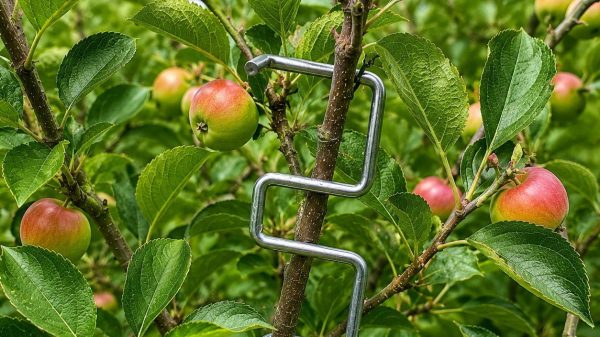
- Allions Global branch bending tool: aluminium, about 10 cm long and 4 mm thick, reusable
- Packs: 100 to 1000 pieces
- Typical use: 2 to 4 tools per young tree, left on for one growing season
What branch angle means
Branch angle is the angle between a side branch and the trunk or central leader. A branch growing almost straight up has a narrow angle. A branch trained outwards, closer to horizontal, has a wide angle. In many fruit trees, growers commonly aim for main scaffold branches somewhere around 45 to 60 degrees from vertical, though the ideal varies by crop, variety and training system.
Why branch angle matters
Stronger branch joints
Very narrow, upright angles tend to trap bark inside the joint as the branch and trunk thicken. These joints are generally weaker and more likely to split under a heavy crop or strong wind. Wider angles usually form stronger joints.
Balance between growth and fruit
Upright shoots tend to grow vigorously and put energy into leaves and wood. Branches trained outwards generally grow more calmly and are more inclined to form fruiting buds. That is why training is a standard tool for bringing young trees into bearing.
Light and air in the canopy
A canopy of wide-angled branches stays open, so sunlight reaches inner leaves and fruit, and air moves through after rain. A crowded upright canopy shades itself and stays damp, which favours disease.
Easier management
Open, low trees are easier to prune, spray, net and harvest, which saves labour every season.
Common training systems
| System | Shape | Common for |
|---|---|---|
| Central leader | One main trunk with tiers of side branches, like a cone | Apple and pear, especially high-density plantings |
| Open centre (vase) | No central leader; 3 to 5 main branches spread outwards | Peach, guava, pomegranate and many tropical fruits |
| Modified leader | A leader kept for a few years, then shortened | Mango, citrus and vigorous trees |
Whichever system you choose, wide branch angles on the main scaffolds are a shared goal. Your local horticulture department or Krishi Vigyan Kendra can advise on the system preferred for your crop and region.
When to train
- Years 1 to 3 matter most. Young wood is flexible and sets quickly in a new position.
- Train during active growth, when shoots are supple. For apple, that is usually the spring and early summer flush; for guava and mango, after pruning when new shoots are forming.
- Do not force old wood. Mature, stiff branches crack if bent hard.
Ways to set branch angles
| Method | How it works | Best for |
|---|---|---|
| Branch spreader (bending tool) | A rigid piece pushes the branch away from the trunk | Young branches up to finger thickness; quick and reusable |
| Tie-down | String from the branch to a peg or lower trunk | Thicker branches and pulling branches lower |
| Weights | Light weights hung on the branch | Gentle bending on flexible shoots |
| Clothes pegs or picks | Clipped at the base of very young shoots | Brand new shoots a few centimetres long |
| Pruning | Remove upright competitors; keep well-angled shoots | All systems, every year |
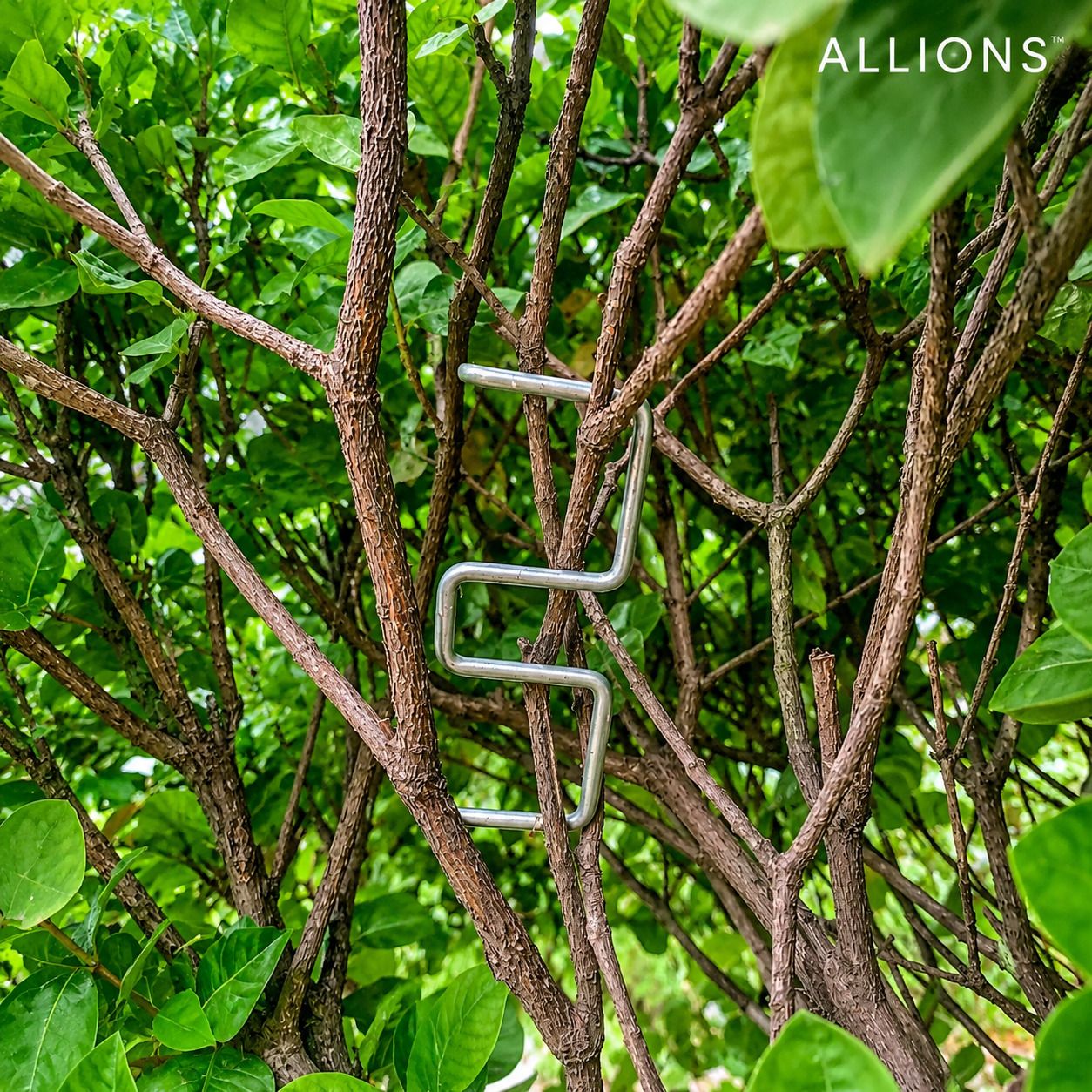
Our aluminium branch bending tool is a zigzag spreader about 10 cm long and 4 mm thick. Hook one end on the trunk and the other on the branch, leave it for one growing season, then move it to the next branch. It is reusable for years. Step-by-step instructions are in branch bending for mango, guava and apple trees.
A simple year-by-year plan
- Year 1: choose 3 to 5 well-spaced main branches. Spread them outwards with spreaders while they are flexible. Remove strongly upright competitors.
- Year 2: move spreaders to the next set of young branches. Check last year’s branches hold their angle on their own.
- Year 3: fine-tune with light pruning. Fit spreaders only where new branches need correcting.
Look after the orchard floor too
Training shapes the canopy, but young trees also need water and nutrients without weed competition. A strip of 1.5 m weed mat along each tree row keeps the base clean; see weed mat for orchard rows. Hold drip lines next to each tree with 16 mm drip pipe stakes.
Common mistakes
- Waiting too long: branches stiffen and become hard to train.
- Bending too far at once: bend gradually; a cracked branch will not recover.
- Leaving spreaders on for years: once a branch holds its angle, move the tool on.
- No plan: pick a training system first, then train every tree to it.
Training a large orchard? Ask us for a bulk quote on branch spreaders, weed mat and drip stakes.
Sources and further reading
- Training Young Apple Trees to the Central Leader System (New Mexico State University, Guide H-333): branch angles of 45 to 60 degrees and the use of spreaders
- Training and pruning apple trees (University of Vermont): university reading on tree training principles
Frequently asked questions
Why does branch angle matter on fruit trees?
Wide branch angles generally form stronger joints, keep the canopy open to light and air, and help balance leafy growth with fruiting. Narrow upright angles tend to be weaker and more vigorous.
What is the best branch angle for fruit trees?
Growers commonly aim for main scaffold branches around 45 to 60 degrees from vertical, but the ideal varies by crop, variety and training system.
When should I train fruit tree branches?
In the first 2 to 3 years, during active growth when shoots are flexible. Do not force old, stiff branches.
What tools are used to train fruit tree branches?
Branch spreaders (bending tools), tie-downs, light weights and clothes pegs for very young shoots, combined with pruning.
Which training system should I use?
Central leader suits apple and pear; open centre suits peach, guava and pomegranate; modified leader suits mango and citrus. Check with your local horticulture department for your crop.
How long should a branch spreader stay on?
About one growing season, until the branch holds its new angle on its own.

LEAVE A COMMENT